


Most leadership development programs are stuck in the shallow end. They focus on fixing what people do, better communication, time management, delegation techniques. But here's what we've learned working with hundreds of leaders: surface-level behavior changes don't stick because they don't address the deeper issue.
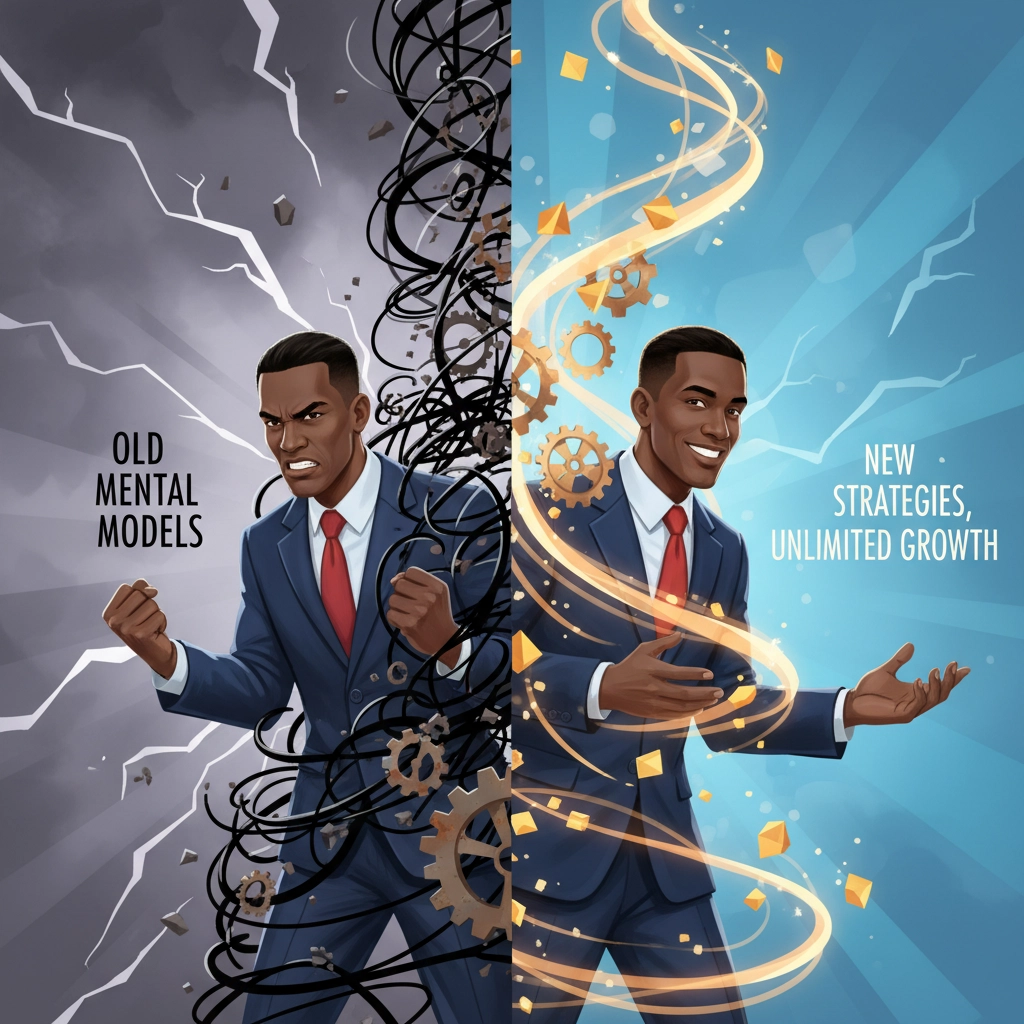
The real transformation happens when you rewire how people think.
The Problem with Behavioral Band-Aids
Traditional leadership training operates like putting a fresh coat of paint on a house with structural problems. Sure, it looks better temporarily, but the foundation issues remain. Leaders learn new techniques, apply them for a few weeks, then gradually drift back to old patterns when pressure mounts.
Why? Because their underlying mental models: the deeply held beliefs about how leadership works: haven't changed.
A mental model is essentially your brain's operating system for how the world works. It's the lens through which you interpret situations, make decisions, and predict outcomes. When a leader's mental model says "I need to have all the answers," no amount of delegation training will create lasting change. The mental model will always pull them back to micromanaging.

The Mental Model Revolution
Transformational leaders understand something their transactional counterparts miss: lasting change requires cognitive rewiring, not behavioral patching. Instead of asking "How do I get people to do this differently?" they ask "How do I help people think about this differently?"
This shift changes everything.
When Southwest Airlines was struggling in the 1970s, CEO Herb Kelleher didn't just implement new customer service behaviors. He fundamentally transformed how employees thought about their role: from "airline workers following procedures" to "customer heroes solving problems." This mental model shift drove behaviors that couldn't be taught through traditional training.
The difference is profound. Behavioral training creates compliance. Mental model transformation creates creativity, ownership, and sustainable change.
The Three-Stage Transformation Process
At Axis Becoming, we've identified three distinct stages that transformational leaders use to shift mental models:
Stage 1: Disrupting Current Thinking
Transformational leaders start by creating productive cognitive dissonance. They don't attack people's existing mental models directly: that triggers defensiveness. Instead, they use intellectual stimulation to help people discover the limitations of their current thinking.
This might look like:
- Asking powerful questions that reveal assumptions
- Presenting data that challenges existing beliefs
- Sharing stories that expand possibilities
- Creating experiences that stretch current mental frameworks
The key is creating enough disruption to open minds without creating so much that people shut down entirely.
Stage 2: Installing New Mental Frameworks
Once the old mental model starts to crack, transformational leaders provide new ways of thinking. They don't just point out problems: they offer upgraded operating systems for the mind.
This requires clarity about what new mental models look like in practice. For example, shifting from a "leadership as control" mental model to "leadership as empowerment" means helping leaders visualize, practice, and internalize what empowerment-based thinking actually feels like in real situations.

Stage 3: Embedding Through Experience
The final stage is where most leadership development fails. New mental models need to be reinforced through repeated experience, reflection, and adjustment. Transformational leaders create multiple opportunities for people to practice thinking differently in low-risk environments before applying it to high-stakes situations.
They also build feedback loops that reinforce the new mental models and catch early signs of regression to old thinking patterns.
Tools for Mental Model Transformation
The Assumption Audit
One of our most powerful tools is the assumption audit: a systematic process for uncovering the invisible beliefs driving behavior. Leaders identify a challenging situation, then work backward to identify every assumption they're making about the people, circumstances, and possible outcomes involved.
The results are often shocking. Leaders discover they're operating from mental models formed years or even decades ago, in completely different contexts.
Perspective Rotation
This technique involves systematically viewing situations from multiple mental frameworks. A leader might examine the same challenge through the lens of a startup founder, a military commander, a therapist, and a systems engineer. Each perspective reveals different possibilities and solutions that weren't visible from their default mental model.
The Future-Back Method
Instead of extrapolating from current reality, transformational leaders help people think backward from a desired future state. This shifts the mental model from "How do we improve what we have?" to "What would we need to believe and do differently to create what we want?"
Creating Psychological Safety for Cognitive Risk
Mental model transformation requires people to admit their current way of thinking might be limited or wrong. That's cognitively threatening. Transformational leaders create environments where intellectual risk-taking feels safe.
They model vulnerability by sharing their own mental model shifts. They celebrate "productive failures" where someone tried new thinking that didn't work perfectly. They make it clear that growth requires letting go of certainty.
Most importantly, they separate identity from ideas. People can change how they think without changing who they are.
The Ripple Effect of Transformed Thinking
When leaders shift from behavioral fixes to mental model transformation, the impact compounds. People don't just perform new behaviors: they start generating new solutions, asking different questions, and seeing possibilities they previously missed.
Organizations develop what we call "cognitive agility": the ability to shift mental frameworks as situations change. This becomes a competitive advantage in rapidly changing markets where yesterday's thinking quickly becomes obsolete.
Beyond Individual Transformation
The most powerful impact occurs when entire leadership teams undergo mental model transformation together. Shared mental frameworks create organizational coherence that no amount of behavioral alignment can achieve.
Teams start finishing each other's thoughts, anticipating needs, and moving in coordinated ways without extensive communication. They develop what researchers call "collective intelligence": thinking capacity that exceeds what any individual could achieve alone.
The Leadership Development Revolution
We're witnessing a fundamental shift in how the most progressive organizations develop leaders. Instead of skill-building programs focused on behaviors, they're investing in cognitive transformation initiatives that rewire how leaders think about their role, their people, and their possibilities.
This isn't just more effective: it's more efficient. When you change the mental model, dozens of behaviors shift automatically. When you only change behaviors, you have to address each one individually.
The leaders and organizations that master mental model transformation will have a profound advantage in the years ahead. They'll adapt faster, innovate more effectively, and create cultures that attract and develop exceptional talent.
The question isn't whether this shift will happen: it's whether you'll lead it or be left behind by it.
The choice between behavioral fixes and mental model transformation is the choice between incremental improvement and breakthrough change. Transformational leaders have already made their decision.
What's yours?

