


The marketing technology world is having a moment. And by "moment," I mean a full-blown existential crisis disguised as a gold rush.
Everywhere you look, there's another AI-powered martech solution promising to revolutionize everything from customer journeys to campaign optimization. The numbers don't lie, 57% of marketers are planning to increase their AI investments by 2025. Customer Data Platforms are projected to grow from $1 billion in 2020 to $3.3 billion by 2025. The tools are getting smarter, faster, and more sophisticated by the day.
But here's the thing nobody's talking about in those glossy tech demos: the companies winning aren't just the ones with the best algorithms. They're the ones whose people have developed the creative mindset to actually use this technology strategically.
And that's where coaching comes in.
The Great Martech Paradox
Let me paint you a picture of what's happening in marketing departments across the country. Teams are drowning in data, overwhelmed by automation possibilities, and paralyzed by the fear that they're not "doing AI right." They've got AI tools for content creation, predictive analytics for customer behavior, automated campaign optimization, and chatbots handling customer service.
Yet somehow, their campaigns still feel generic. Their personalization efforts are creepy instead of compelling. Their "AI-optimized" content sounds like it was written by a committee of robots.

The problem isn't the technology, it's that we're treating AI implementation like we're installing new software when we should be treating it like we're developing a new organizational capability. The mindset shift required is massive, and most companies are trying to skip right over it.
Here's what I see when I work with marketing teams: they're stuck in what I call "execution mode." They're asking, "How can AI make this task faster?" instead of "What becomes possible now that wasn't before?"
That's not just a subtle difference in perspective, it's the difference between incremental improvement and competitive advantage.
Beyond the Hype: What Creative Mindset Actually Means
When we talk about "creative mindset" in the context of AI, we're not talking about making prettier graphics or writing snappier headlines. We're talking about developing what researchers call "augmented creativity", the ability to think strategically about human-AI collaboration.
This starts with understanding that AI isn't doing the thinking for you. It's amplifying your thinking. The most successful marketing teams I work with have figured out that their role isn't to become obsolete, it's to become the strategic conductor of an incredibly powerful orchestra.
Think about it this way: AI can analyze customer data patterns faster than any human ever could. But it can't understand why your brand's voice matters to your audience in a way that transcends data points. It can optimize for click-through rates, but it can't recognize when optimizing for clicks undermines long-term brand trust.
The creative mindset means leading with critical inputs that only humans can provide: deep audience understanding, brand positioning nuance, and business goal clarity. Then, and this is crucial, communicating those insights to AI systems with precision and direction.
The Hyperadaptive Shift
Here's where it gets interesting from a coaching perspective. The organizations that are actually succeeding with AI aren't just adding new tools to their existing structure. They're fundamentally reorganizing how they operate.
I call this shift moving from "linear" to "hyperadaptive" organizations. Linear organizations function like assembly lines: information travels up for approval, decisions flow down with revisions, and authority correlates with hierarchy. This worked fine when marketing moved at the speed of quarterly campaigns and annual budgets.
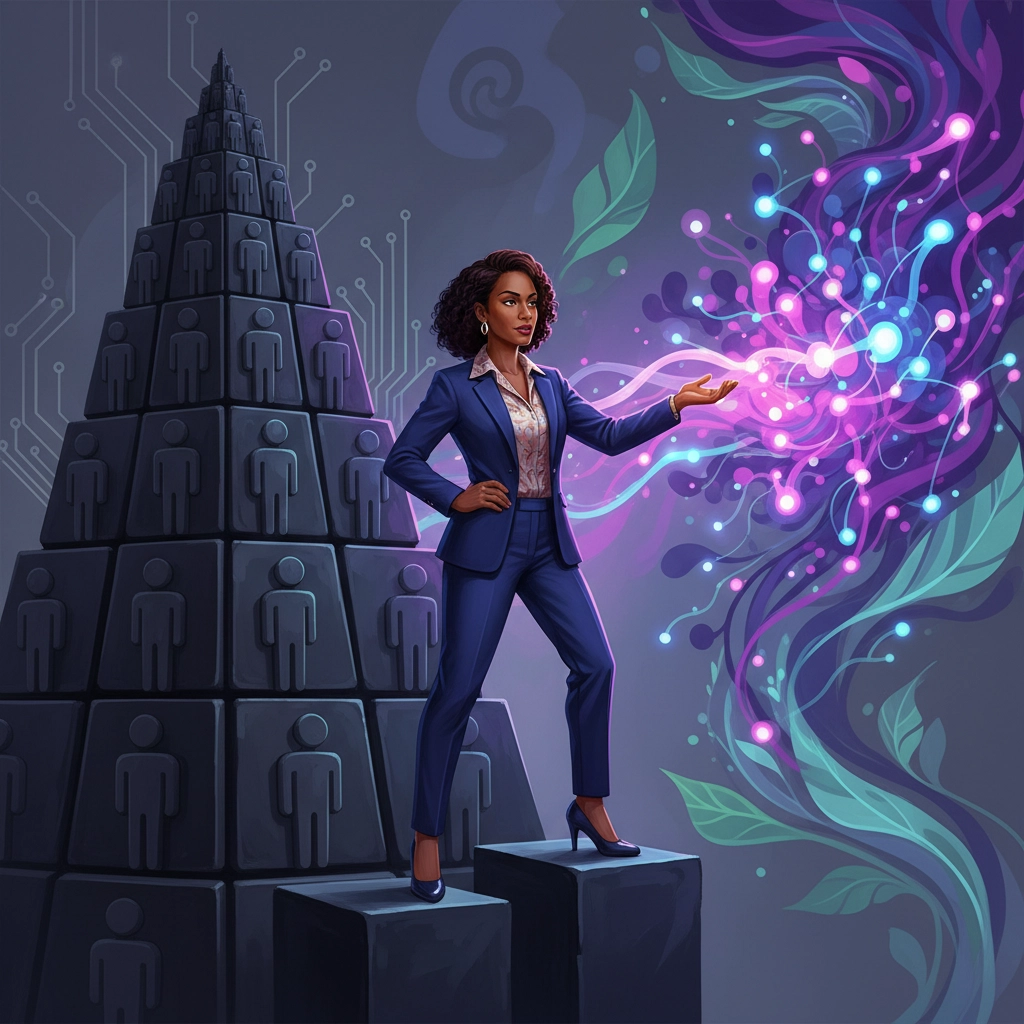
But AI-powered marketing operates at the speed of real-time data processing and automated optimization. When your ad spend can be adjusted every few minutes based on performance data, when your content can be personalized for thousands of micro-segments, when your customer service can handle complex queries instantly, linear organizational structures become the bottleneck.
Hyperadaptive organizations, on the other hand, sense their environment in real-time, process information collaboratively across teams, and respond with remarkable speed to market shifts. They evolve continuously through real-time insights rather than periodic strategic reviews.
McDonald's provides a fascinating example of this in action. They've implemented edge computing infrastructure where individual locations process data locally while simultaneously feeding insights into collective intelligence networks. This enables marketing decisions at unprecedented speed while maintaining system-wide learning.
Coaching the Mindset Transformation
So how do you actually develop this creative mindset in your marketing teams? It's not something that happens overnight, and it's definitely not something that happens just by buying better software.
Start with strategic confidence. Most marketing professionals have been conditioned to wait for approval before making significant decisions. But AI-powered marketing requires teams to make strategic calls at the speed of data, not the speed of meetings. This means coaching team members to develop deeper expertise in the areas where human judgment remains irreplaceable: audience psychology, competitive positioning, and business outcome connection.
Reframe optimization as reinvention. Instead of asking "Can AI make this faster?" start asking "What becomes possible now that wasn't before?" This shift moves teams from incremental thinking to transformational thinking. When Spotify uses AI to create personalized playlists, they're not just making music discovery faster, they're creating entirely new forms of musical experience that wouldn't be possible without AI.

Build collaborative decision-making muscles. Linear organizations are hierarchical by design. Hyperadaptive organizations are collaborative by necessity. This means coaching teams to share insights laterally, make decisions at the edge (closest to the customer data), and contribute to collective intelligence rather than waiting for top-down direction.
Develop AI partnership skills. This is more nuanced than "learn how to write prompts." Teams need to understand how to set clear boundaries for AI systems, evaluate whether AI outputs align with brand values and business objectives, and iterate on AI collaboration in real-time. It's like coaching someone to be a better dance partner, the technical steps matter, but the real skill is in the fluid responsiveness to your partner's movements.
The Practical Reality
Let's be honest about what this looks like day-to-day. You're not just dealing with technology adoption, you're dealing with identity shifts, skill gaps, and organizational inertia. People are worried about their jobs. Teams are overwhelmed by the pace of change. Leaders are making significant investments without clear ROI metrics.
This is fundamentally a coaching challenge, not a technical one.
The marketing professionals who are thriving in this environment aren't necessarily the ones with the most technical expertise. They're the ones who've developed the confidence to experiment, the strategic thinking to ask the right questions, and the collaborative skills to work effectively with AI systems.

They understand that the competitive advantage isn't in having the most sophisticated AI tools, it's in having the creative mindset to use those tools as amplifiers of human capability rather than replacements for it.
What Success Actually Looks Like
When teams get this right, the results are pretty remarkable. Instead of generic, AI-generated content that sounds like everyone else's AI-generated content, they create campaigns that feel both data-driven and authentically human. Instead of creepy personalization that makes customers feel surveilled, they deliver relevant experiences that feel thoughtful and helpful.
Their campaigns respond to market shifts in real-time without losing brand consistency. Their customer experiences feel both automated and personal. Their creative output scales without sacrificing quality or authenticity.
But getting there requires more than new software. It requires coaching teams through a fundamental shift in how they think about creativity, collaboration, and competitive advantage in an AI-powered world.
The companies that invest in this mindset development: not just the technology implementation: are the ones that will own the next decade of marketing innovation. The question isn't whether your team has access to AI tools. The question is whether they have the creative confidence to use them strategically.
That's the coaching opportunity none of the martech vendors are talking about. And it might just be the most important conversation your organization needs to have right now.

