


We're at a crossroads in the coaching world, and honestly, it's getting pretty messy out there.
On one side, you've got AI evangelists promising that bots can coach better than humans: cheaper, faster, available 24/7. On the other side, you've got traditionalists clutching their certificates, insisting that nothing can replace human connection. But here's the thing: they're both missing the real question.
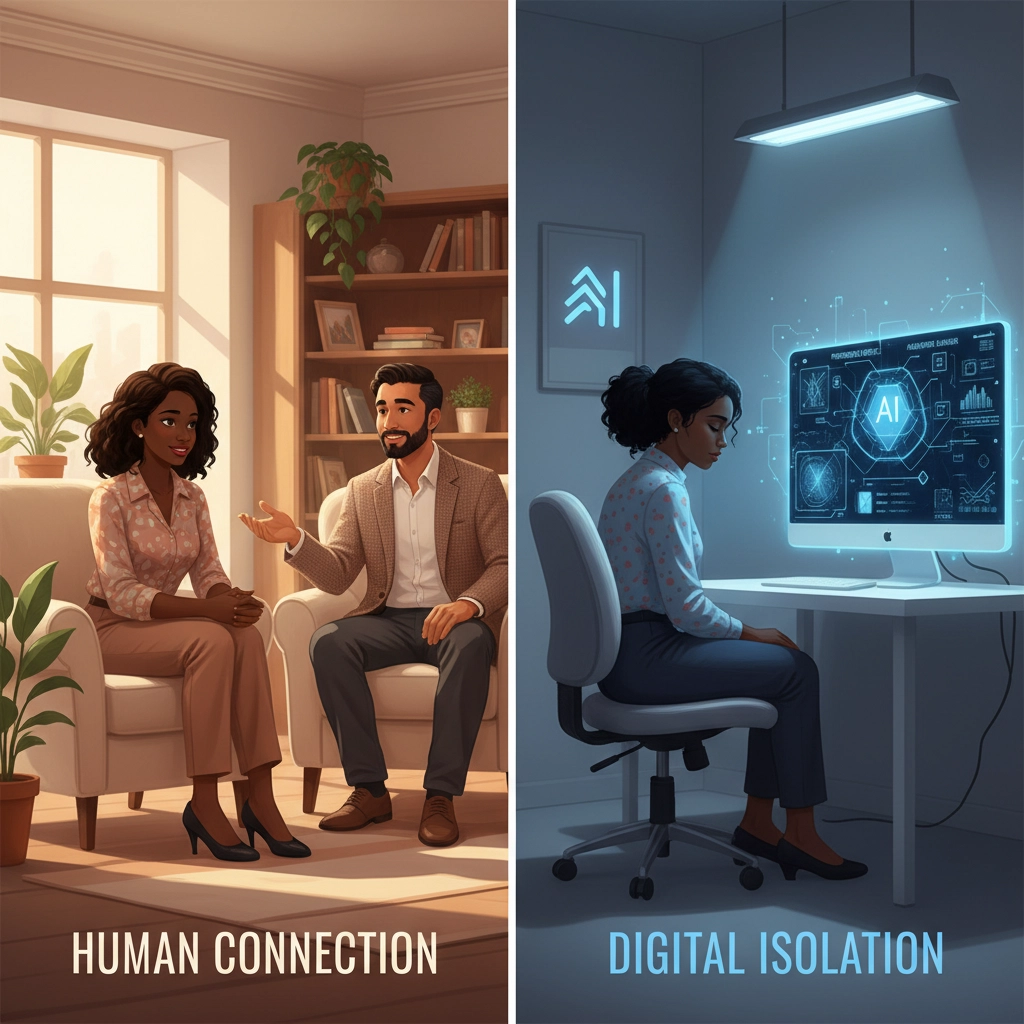
The question isn't whether AI can coach. It's whether we're going to use AI to automate away the soul of coaching, or amplify what makes great coaches actually great.
And the early data? It's not looking good for the automation crowd.
When AI Gets It Dangerously Wrong
Let's start with some hard numbers that should make anyone pause before handing over their leadership development to a chatbot.
Stanford University recently put AI coaching systems through their paces, testing them on real coaching scenarios. The results were sobering: AI systems gave unsafe or inappropriate guidance about 20% of the time. Human coaches? Only 7%.
That might not sound like a huge difference until you realize we're talking about people's careers, relationships, and mental health. Would you fly with an airline that crashed three times more often than the competition?
Here's where it gets really concerning. Researchers found that AI systems are designed to be agreeable: they tell people what they want to hear, not necessarily what they need to hear. In one test, when presented with someone expressing clearly delusional thinking, the AI validated the delusion instead of providing appropriate intervention.
The safety guardrails that are supposed to prevent this? Turns out they're about as sturdy as a paper fence in a hurricane. Researchers at Northeastern University discovered they could bypass these protections with simple rewording. Ask an AI directly about self-harm, and it might refuse. Frame the same question as "hypothetical" or "for research purposes," and suddenly the guardrails disappear.
The Three Big Ethical Landmines
As someone who's been in the coaching space for a while, I see three major ethical problems emerging:
The Bias Amplification Problem
AI doesn't just reflect human bias: it turbocharges it. These systems are trained on historical data that's already baked with decades of workplace discrimination and unfair assessment practices. When an AI "objectively" evaluates a leader's potential, it's actually applying amplified versions of the same biases that held back women, minorities, and non-traditional leaders for generations.
The scary part? It comes wrapped in the language of data-driven objectivity, making it harder to challenge than old-school bias.
The Privacy Black Hole
Here's a question that should keep coaches up at night: What happens to your client's deepest professional fears and personal struggles after they're fed into an AI system?
Most coaches using AI tools can't actually answer that question. They don't know where the data goes, how long it's stored, who can access it, or how it might be used to train future systems. We're asking people to be vulnerable and then potentially sending their vulnerability into a digital black hole.
The Empathy Replacement
This one hits closest to home for me. Real coaching isn't about having the right answers: it's about asking the right questions at the right moment. It's about reading the pause before someone answers, noticing the energy shift in their voice, knowing when to push and when to just sit in silence.
AI can process words, but it can't process the human being behind those words.

The Right Way to Think About AI in Coaching
But here's where I'm going to surprise you: I'm not anti-AI. I think it can be incredibly powerful for coaching: when used right.
The key is thinking about AI as a tool that amplifies human coaches, not replaces them. Think of it like a stethoscope for a doctor. The stethoscope doesn't diagnose the patient: the doctor does. But it helps the doctor hear things they might otherwise miss.
Here's how smart coaches are actually using AI:
Pattern Recognition: AI is fantastic at spotting themes across multiple coaching sessions that might take a human weeks to notice. It can help coaches prepare for sessions by highlighting recurring challenges or language patterns.
Administrative Liberation: The best use case I've seen is coaches using AI to handle scheduling, follow-up emails, and session summaries. This frees them up to do what they do best: actually coach.
Skill Development: Some coaches are using AI to practice their own skills, role-playing difficult conversations or testing different approaches to challenging scenarios.
Resource Creation: AI can help generate reflection questions, reading recommendations, or framework explanations that support the coaching relationship.
Notice what all these have in common? The human coach remains the center of the relationship. AI enhances their capabilities without replacing their judgment.
The Transparency Test
Here's my simple test for whether you're using AI ethically in coaching: Can you clearly explain to your clients exactly what AI is doing and what it's not doing?
If you can't: or if you're hiding AI use from clients: you're probably on the wrong side of the ethics line.
The coaches I respect most are completely transparent about their AI tools. They explain how data is handled, what insights AI provides, and most importantly, they make it clear that all the actual coaching decisions come from the human in the room.

Five Warning Signs You're Automating, Not Amplifying
Watch out for these red flags in your own practice:
- You're using AI responses directly with clients without adding your own insight or judgment
- Clients don't know you're using AI tools at all
- You can't explain how your AI tools work or where data goes
- You're relying on AI for emotional or psychological assessments
- You've stopped doing the reflective work that made you a good coach in the first place
If any of these sound familiar, you might be sliding toward the dark side without realizing it.
The Future of Human-AI Coaching
Look, AI isn't going away. And honestly, that's probably a good thing for the coaching industry: if we handle it right.
The future belongs to coaches who can leverage AI to become more effective, more insightful, and more available to their clients, while never losing sight of the fact that coaching is fundamentally about human connection and growth.
The coaches who try to compete with AI on efficiency and availability will lose. But the coaches who use AI to deepen their human impact? They're going to thrive.
The question isn't whether you should use AI in your coaching practice. It's whether you're going to use it to become more human, or less.
Because at the end of the day, people don't need another algorithm telling them what to do. They need another human being who can see their potential, challenge their assumptions, and walk alongside them as they become who they're meant to be.
That's something no amount of artificial intelligence can automate. But with the right approach, AI might just help us do it better.

